


The truth behind the fret work on Warmoth replacement necks.
-
 Aaron Cheney
- Guitar Necks
- Dec 27, 2023
-
10411views
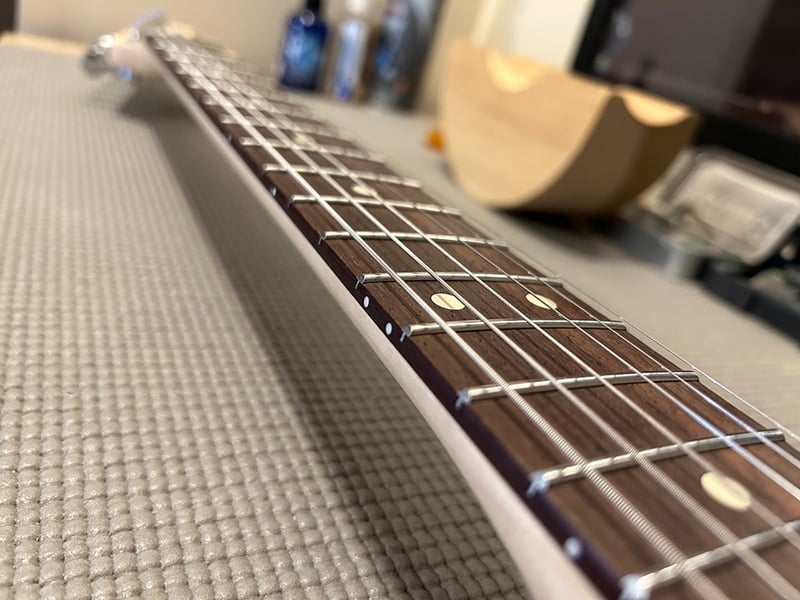
In the world of manufacturing, guitars - and replacement necks in particular - are an unusual challenge. They forge an unholy alliance between organic materials that move and flex with changes in their environment and the need for precise tolerances with easy adjustability. These final adjustments are also highly personal, meaning that what is preferred by one player might not work for another.
This raises some difficult questions for companies that manufacture guitars. How do you construct guitars to high tolerances, while still accounting for wood’s tendency to shift and move? How do you make them precisely adjustable? How do you ship them to destinations around the world and have them arrive playing the same way they did when they left the factory?
The Neck is Where It's At
It’s probably fair to say that the neck is the part of an electric guitar most sensitive to changes in the environment. Ironically, it’s also the part that players are most sensitive to. Even hundredths of an inch can be felt and affect an instrument’s performance. For this reason, manufacturers have given much attention over the years to things like neck construction techniques, truss rods, fretboard radius, and nut width. And perhaps most of all, the frets. The best guitars arrive with highly detailed fretwork done at the factory. The frets are well seated, perfectly leveled, crowned and polished, and oftentimes rolled or balled on the ends.
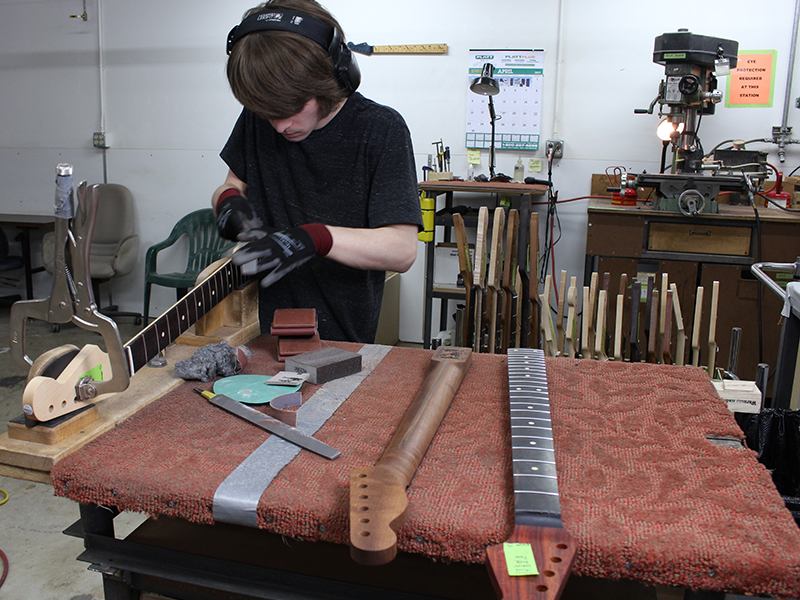
Warmoth's Fret Work
Warmoth is often asked about the quality of our fretwork, and how much gets completed before a neck leaves our shop. Warmoth glues and then presses our frets into place. We then back-bevel the fret ends to about 30 degrees, and polish them to a smooth finish. Most Warmoth necks will arrive playable out of the box. In fact, I own many personal Warmoth necks and gig with them regularly, and have never done anything to the frets at all.
That being said, any guitar or bass neck will benefit from finely detailed fretwork. Warmoth does not do any leveling, polishing, crowning, or rolling, and there are several reasons why. When you consider that Warmoth makes replacement parts rather than complete guitars the reasons become more apparent. Making parts has different challenges, and requires a different approach.
First, unlike companies that make complete guitars, when our necks leave the shop they have never been under the tension of strings. Depending on what gauge of strings a player uses this tension can be between 75 and 200 lbs; certainly enough pressure to cause a neck to shift. The truss rod has also never been tightened against the tension the strings will create, and when it is it will exert its own pressure from within the neck.
Second, a large percentage of the necks we ship do not have a protective finish applied yet. Our necks are made in the temperate climate of the Pacific Northwest, and then shipped to locations all around the world, where differences in temperature, humidity, and altitude can cause wood to expand, contract, or shift.
For these reasons, we feel fine fretwork is better left until after a neck has been assembled and allowed to settle into its new climate and the tension of the strings. Doing the fretwork before this has occurred would often result in the need to do it again post-assembly, and customers would end up paying for the service twice.
Rolled Edges
Rolled fretboard edges is another thing we are asked about frequently. On more than one occasion I’ve held a Warmoth replacement neck in one hand and a competitor’s “light rolled” neck in the other, and they are essentially the same. In some cases I've even found Warmoth’s fretboard edges to be slightly more softened.
This competitor also does a “heavy rolled” fretboard, and the reason they are able to do this is because they only offer oil finishes on their replacement necks. At Warmoth we do hard finishes on our necks, which makes heavily rolled or rounded fretboard edges problematic on necks with dark fretboard woods. On these necks the fretboard does not recieve a finish. This means that the hard finish coming around from the back of the neck must be somehow terminated along a large, rolled edge radius.
We have also found that heavily rolled fretboards create playability issues when used with bridges that have a wide string spacing, such as the Floyd Rose tremolo system. In these cases players can find that strings continually slip off the edge of the neck.
For all these reasons, Warmoth has elected not to offer heavily rolled fretboards.
What’s That Stuff on My Frets?
If you order a neck with a maple fretboard, and you order a finish, the entire neck will be finished including the fretboard and frets. We do not remove the finish from the frets, but don't worry. It will wear off quickly with play. A fret leveling operation will also take it off.
If you ordered a Vintage Tint finish, the frets may even appear gold. Again, no need to worry. Once the finish has worn off the frets will look normal.
If you prefer, you can also quickly remove the finish following these steps:
Stop Fretting
You didn't think you were getting through this article without that tired pun, did you? But it is worth saying again: there is nothing to worry about when it comes to Warmoth's fretwork. Our fret installation technique is the best in the replacement parts business. Are Warmoth necks playable as they are received? Yes. Will Warmoth necks benefit from fine fretwork? Yes, after they have been assembled and allowed to settle for a bit.
After building Stratocaster® and Telecaster® replacement necks for more than 40 years, these are the solutions we have found to work the best, for the most people.